May 16, 2008

Random Q&A: Lisa McMann

Lisa McMann is a former blueberry picker and, more recently, a New York Times bestseller; her first novel, Wake, is nominated as a Best Book for Young Adults by the American Library Association. The sequel, Fade, will be on sale on February 24, 2009.

1) What is your writing day like?

Intense. On the days I am writing, I write fast and barely stop for air, much less lunch. It all starts at precisely 8:22 a.m. when the last family member leaves the house for school, and it usually goes until 2:30 or 3 p.m. I drink a couple Diet Cokes in there, maybe stand up a few times to stretch, or go outside to sit in my thinking chair if my brain needs a breather. I love days like these.

2) We’ve heard about “the call” when someone gets an agent/a publisher. What was “the call” like when you heard you were on the NYT Bestseller List?

My agent called me on a Wednesday afternoon and said that Jen, my editor, wanted to talk to us both. He then hooked Jen up with the three-way calling thing and while I was waiting for Jen to come on the line, I was just sitting there, wondering what was up – I actually thought she was calling to say that they were disappointed in sales or something, or that maybe there was a problem and they no longer wanted to publish FADE…of course I’m as neurotic as any author.

So when Jen came on the line, she says something like, “I just wanted to let you know that I am talking to a New York Times bestselling author!!” only she kinda screams that last part and I absolutely can.not.believe it. So I said something like Shut. Up. and we all three were talking at once, so excited, and I said “No WAY!!” about a hundred times.

And it was the absolute best day of my entire life. (My husband doesn’t mind that it was better than our wedding day, which really sort of sucked.)

3) What is the hardest part of the writing process for you?

Editing the rough draft.

4) What is the easiest part of the writing process for you?

Writing the rough draft.

5) I know you’ve mentioned publicity in another interview. Specifically, you mention your MySpace page. How exactly does a writer or wannabe writer create a MySpace page that gets people to go there?

This is a GREAT question. And I don’t have the answer. I only know how to have a Myspace “presence,” whereby I go out and find people who like to read YA books, and hang out and talk with them.

A lot of authors feel like it’s up to the fans to find them. I love it when fans find me, but those people already know about the book. I want to find future fans, too. We as authors need to be humble enough to seek them out.

So you find an author who 1) has a lot of fans on Myspace already and 2) writes similarly to what you write, and you find readers on their pages. I prefer to befriend people from their “new friends” list and comments rather than their top friends so I don’t end up wasting time befriending people who haven’t logged on since June of 2006.

You send a friend request to them. If the person accepts your friend request, a thank you is in order. Please don’t start the conversation out by saying, “Hey, I have a book coming out that you might like!” I hate when people do that to me. If they want me to buy their book (or CD or whatever), they need to court me a bit. At least pretend like they care, you know?

You might want to mention that you found them on Cassandra Clare’s (or whoever’s) Myspace page and you wonder if they’ve read City of Ashes yet. Or comment on another book in their “favorite books” section that you’ve read too. You have a conversation with a fellow book lover.

Be a friend first. Your page should have all the info about your books on it – when your friends come to like you, they’ll naturally grow curious about your book and ask. And they’ll read your bulletins and blogs, too – that’s where you sell your book. And over time, they’ll be pulling for you! They’ll spread the word about you and your book, forward your bulletins to their friends, all because you took the time to establish a reader-in-common relationship with them.

Yes, it takes a ton of time. And it’s not for everybody – you have to enjoy interacting this way. But when I see teens posting on blogs, “Lisa McMann’s book WAKE is amazing and she’s really nice too – she’s my Myspace buddy!” I sort of melt a little. And I know that my effort paid off not only in word of mouth advertising, but also in a loyal friendship with some pretty amazing, invisible people.

For more Lisa, visit her website and blog.

May 15, 2008

Amanda’s Randoms: The ‘What If’ Way of Finding Your Story

I suffer the same 20-page slump Angie does. I have quite a few first chapters I’ve banged out in one sitting and then—nothing. My first two books started this way, with many a moon waxing and waning until I was able to type “Chapter Two.” I have several other stories that may never get that far, but all of my story ideas have one thing in common—the question “What if?” Here are some what if’s that turned into stories, and one that will forever be missing that second chapter.

1) What if your life had hit such a low that when your ex-boyfriend/new vampire shows up, you actually consider inviting him in? This is the premise for my first book, Uninvited. Uninvited is not a vampire romance—it’s about a teen who has two options—clean up the mess she’s made of her life or open the window—and we all know what that means. After I banged out that first chapter, I pondered for quite awhile about the frame of mind someone would have to be in to actually considered inviting a vampire in. To echo Angie—next come all the subplots. How had things gotten so bad? What obstacles, besides the vampire professing his undying love, were in her way? What if her friends were keeping her life back on track? What if her ex-boyfriend’s true motivations for coming back for her—over all of the other girls he’d dated—were not what they appeared to be?

2) My next what if came to fruition after eight years of pondering! When my daughter was a baby, I’d rock her at night as I looked out her window. One evening I wondered what it’d be like if a girl lying in bed saw four people fly past her window on broomsticks. I imagined she’d be scared, and while I loved the idea, I couldn’t figure out why these people were out to get her. Eight years later the next what if question came to me—what if the night fliers were her friends? I got to the keyboard and wrote the first chapter for Revealers. While I was typing, the what if’s kept coming. What if hunting werewolves and vampires is not the public service the girls think it is? What if their coven is keeping a huge secret from them? What if the girls rebel?

3) Another what if came after visiting the amusement park, Story Land, in New Hampshire two years ago. I watched the kids working there—many of them bored to tears as they repeated the same instructions over and over again. I watched toddler meltdowns, fellow park goers getting sunburned in long lines, and costumed characters sweating in the July sun. I thought—who would want to work here? And then came the what if. What if someone got a job there just because her boyfriend did? What if she did it because she knew his best friend—a girl named Alexa—was also working there and she didn’t want to leave them alone?

I wrote my first chapter very quickly, but then I ran into trouble. My editor likes my paranormal stories. Would she like my teen romance without things that go bump in the night? So I pondered some more, and a year later I got another what if. What if the owners of the park are the descendants of the real Snow White? What if Snow White didn’t get her happily ever after, and the repercussions of that are still affecting her descendents? I added a few more what if’s to develop the subplots, and I ended up with my paranormal partial Devoured.

4) Here’s the what if that most likely won’t go farther than the first chapter I wrote. Aliens Online. What if Aliens can read our emails? What if a sci-fi loving boy emails a friend saying he’d paying a million dollars to have the aliens in his favorite book series take his annoying older sister away? What if the aliens take him seriously and he has to rescue his sister? What if his sister doesn’t want to be rescued?

After thinking about this story for a few months, I finally decided I wasn’t invested in finding out all the answers to my what ifs, and the story is tucked away in a folder just in case some new and better what ifs pop up.

5) So if you’re stuck for ideas, start asking yourself questions—each what if can lead your plot in a new direction. Some will stick, and others will lead to more questions and hopefully a fully realized story!

~A.M.

May 14, 2008

Angie’s Randoms: The Page 20 Slump

I have an affliction. A great story idea rockets into my head, I spin out the first chapter, and then–poof!–my mad-typing fingers screech to a halt. Take a look in my desktop folder labeled “Projects” and you’ll find about ten of these 20-page do-hickies. Why do I do this? How do I regain the momentum I had when I first started writing? So far, I’ve managed to take one of these slump projects and forge through, completing it. Here’s what I learned about getting past the 20-page slump.

1) The first plot line is not always the right plot line. For me, I had a great character in mind, and an exciting setting. I just didn’t have the right theme. If something isn’t clicking, but you still love your main character and/or setting, trying rethinking the plot. Is it really a coming-of-age? Or is it a mystery? Or is it a romance?

2) Your character’s “want” might need some changing around. What your character(s) main want is, and how they set out to get it, is a huge aspect of your story. My MC’s want just wasn’t compelling enough, and I didn’t realize it until I’d let the story slump and sit for a while. I tried adding a new layer to her main want (in her case, going from “wanting to be taken seriously by adults”—snore—to “wanting to overcome her clumsy nature and become the apprentice to her famous detective uncle”). I’d intrigued myself again, and couldn’t wait to write.

3) Subplots are essential and exciting. When I read a book, I like to be thrown into numerous plots—a main plot, and accompanying subplots. These help tremendously when advancing the story and keeping it exciting for the reader. The main plot might become boring, even for you, the writer.

4) The conflict needs serious stakes for someone to seriously care. I will admit, ratcheting up the stakes for my MC always comes later during revisions. Like the “want,” the conflict needs to be substantial, the consequences dire. Try asking yourself, “What if my main character doesn’t get what she wants?” If there is no real consequence, take another look at what she risks and how to make it more intense.

5) Maybe a “great idea” is all it is—for now.
I’ve come to terms with some of the 20-page slumps sitting in my Projects folder. I never completely give up on any of them, but to help me move forward with other projects, I set it aside and let the story percolate in my subconscious a little while. The story will be there when I’m ready to come back to it, and perhaps by then things will have settled into place.

~A.F.

May 13, 2008

Susan’s Randoms: Lighting Can Strike 5 Times

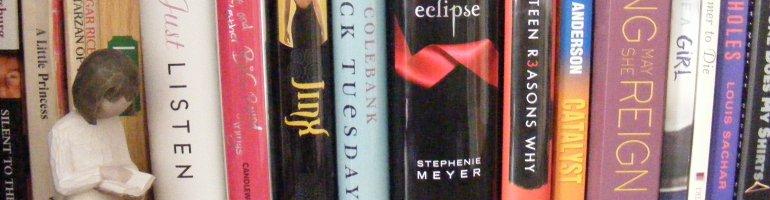
First, let me say that coming up with the idea for Black Tuesday was right up my alley. When Penguin asked me to come up with 10 story ideas based off news stories, I was in hog heaven. I was already doing that! I stalk sites like CNN and Salon, and I even subscribe to Reuter’s Oddly Enough news. So when I read how actress Rebecca Gayheart had accidentally killed a child with her car, the seed for Black Tuesday started to bloom (and what eventually got Penguin to buy Black Tuesday).

That said, I feel like I am one of the most receptive people out there in terms of getting inspired–sort of like a lightning rod for all things inspirational. I get inspiration from just about anything, and these ideas are scrawled on check registers, gum wrappers, even those subscription cards in the middle of magazines.

For instance, I get inspiration from the mom at Target threatening that if the five-year-old doesn’t put down the Elmo bathsoap, Santa’s not going to come. I get inspiration from the line in a magazine article that talks about Charlize Theron getting discovered while throwing a temper tantrum in a bank line. I get inspiration when I stand on the side of the road, getting offered a glass of water from a woman who lives in a trailer twenty feet where I just had a car accident. But here are a few ideas about how to become a lighting rod for inspiration you may not know about:

1) I get inspired while I’m, uh, using the facilities. Or on the treadmill. Or at a stoplight. Sometimes, we get so wrapped up in our stories that our brains are constantly churning and we can’t figure out how to solve a plot point/fix a character flaw/come up with a title that will make our publisher smile with relief. I find my best thinking time is when I have a clear mind, such as when I’m thinking about getting to the post office before it closes (i.e., at a stoplight) or trying not to die as I sprint the last two minutes (i.e., on the treadmill) or praying the lock holds while someone outside is pounding on the door (i.e., using the facilities). The point I’m trying to get to is that you have to allow yourself to have a blank mind. It’s okay. You’re not doing your story a disservice by putting it on a back burner. You know what they say about a watched kettle, after all… (Cliches are my drug of choice, people.)

2) Hello. I’m Susan, and I’m a collager.
I know that other writers admit to this–namely Linda Lael Miller and Jennifer Crusie–but I became obsessed with collages when I was about 10, cutting out my favorite dresses/houses/furniture from magazines and splicing them together into those static-cling photo books. I now do that for my stories, and I do them in my cheap paint program that my husband made me download for free off the Internet (Gimp–it does the job, but I miss my namebrand paint program!). Anyway, I find the actors that most resemble my hero and heroine, and then I find the heroine’s house, the heroine’s town (or at least a town that would resemble hers), maybe the dress she wears during a pivotal scene, possibly the candy she’s obsessed with, or the jalopy she drives to school. The point is to spend an afternoon making your protagonist real. And once you have, turn it into your desktop so that it’s constantly there to nudge you when you’re blocked and need an idea about what your protagonist’s world needs in order for it to be torn asunder.

3) One day, I really, really, REALLY want to give a workshop about why writers should watch more TV.
Inevitably, I find a way to dig myself out of a go-nowhere scene by watching an episode of True Life or Dr. Phil and I get struck by a nugget of gold. The key? Watching documentaries (or, more aptly, documentary-lites) helps me round out characters. For instance, where else can you get inspired by an overweight girl who enters beauty pageants and dates a guy 50 pounds lighter than her (True Life)? Then again, maybe this is the curse of the new mom who lives in Small Town, America. I can’t exactly get out too often to experience real life. I know a lot of people like this, actually. So c’mon, people, live your life vicariously through TV! It’s not like I’m asking you to do lines of coke or watch Barney or anything.

4) People need people–specifically, writers need routine meetings with their critique groups to brainstorm and trip over a spark of inspiration.
For instance, it was while I was at a face-to-face meeting with my critique group in Phoenix (who have been my online group ever since I moved 3,000 miles away two years ago) that one partner told me something that would’ve resonated with her as a girl with no money and no hopes (which is the gist of my protagonist in my second book). My oh-so-wise partner said, “A trip to the grocery store used to be painful, looking for generics, sales, dented cans, and never getting to buy what you really wanted.” (This is a paraphrase, but you get the idea.) Her heartfelt words drawn from her own experience gave me a better opening scene. And perhaps, just perhaps, a stronger theme. Thank you, S4.

5) And here’s one more cliche for you: I get ideas while reading writing books. But don’t become a writing book obsessive compulsive. I’ve known some people who just read writing books and haven’t really put finger to keyboard to actually write anything. I pick up a writing book probably twice a year, when I’m stuck. Lately, I’ve been reading Write Away by Elizabeth George. It was while I was reading her book aloud to my baby (hey, it helps her fall asleep AND mommy gets some reading done) that I fell onto these words: “To avoid merely reporting on a setting, to render it instead–which implies bringing it to life–the craftsman puts place into action, knowing that the best use of details comprises details in motion.” I actually slowed down over these words since I’m trying to world-build a small New England town, and these words came at the exact right moment.

Here’s hoping you get struck by inspirational lightning soon. Just be receptive. And wear a lighting rod.

~S.C.

May 12, 2008

Robin’s Randoms: 5 Ideas for Fixing a Creative Drought

Ideas are everywhere. Maybe they come when a guy cuts you off on the freeway, or when you see an ad that sums up your character’s mantra. The universe is filled with ideas when our creative wells have run dry. We just need to be receptive.

1) Emotion. Ask yourself: What has hurt you? Who has hurt you? What makes you laugh? What makes you angry? Dig deep to find the things that still stick with you even after you’ve grown. The seed of an emotion can begin a story.

2) Words. Sometimes all it takes is a word to generate something big. I love to play with words. Single words, two word titles, phrases, pitches for possible stories, and lines of dialogue from nowhere. Words without a specific story are free and often give me the gift of a title and/or idea. Get out a notebook and let the words fly!

3) Pictures. Photographs from my childhood often fill me with ideas. It’s the way they are loaded with emotion, memories, unsaid things and untold stories. Other people’s pictures can do the same thing. If I have a character and I need to focus on her I scour magazines until I find her. Then I make a collage with all her stuff. Play and the ideas come!

4) Stories. Books, T.V., film, and music can generate ideas. It’s scary to know that someone’s work gives you ideas, but that’s the nature of creativity. Unless you are copying a work, which is illegal and unethical, being inspired by another work is a wonderful surprise. It means you are receptive.

5) Life. Sometimes you may feel washed out, dried up, and just plain empty. Remember that you have to refill your creative well. You can’t be receptive to ideas if you are exhausted. Remember what feeds you (other than chocolate) and do those things. Hike, talk with your writing group, take a course, paint, cook, read, and try something new.

~R.M.M.

Next Page »